

Dogs are more than just loyal companions—they’re highly intelligent creatures with remarkable cognitive abilities. Modern training techniques focus not just on obedience but also on nurturing and enhancing a dog’s mental development. Learn the methods behind training smart dogs!
Understanding Canine Intelligence
Before diving into advanced techniques, it’s essential to recognize the three primary types of intelligence in dogs:
- Instinctive Intelligence: Skills and behaviors innate to a breed, such as herding in Border Collies or retrieving in Labradors.
- Adaptive Intelligence: A dog’s ability to solve problems and learn from its environment.
- Working and Obedience Intelligence: How well a dog learns commands and works with humans.
Advanced training strategies aim to engage all three aspects, turning lessons into mentally stimulating exercises.
The Science Behind TRAINING SMART DOGS
Modern training methods leverage insights from behavioral psychology and neuroscience. Positive reinforcement remains the cornerstone, rewarding desired behaviors to create strong neural associations. Adding cognitive challenges—like puzzles or problem-solving tasks—stimulates the prefrontal cortex, enhancing memory and decision-making skills.
Advanced Dog Training Techniques
1. Clicker Training 2.0
Clicker training pairs a clicking sound with rewards, marking desired behaviors. Advanced use involves shaping complex behaviors by rewarding incremental steps. For instance, training a dog to fetch specific items by name requires breaking the task into smaller components and using the clicker to reinforce each step. Cats can also be clicker trained. Read more here!
2. Scent Work
Dogs naturally excel at identifying scents. Channel this skill into activities like search-and-rescue simulations or finding hidden treats. Start simple and gradually introduce more complex challenges, such as differentiating between multiple scents.
3. Interactive Toys and Games
Puzzle toys, like treat-dispensing balls or interactive boards, challenge a dog’s problem-solving abilities. Games like hide-and-seek encourage them to use both their minds and noses.
4. Behavioral Sequencing
This technique trains dogs to perform a sequence of behaviors, such as running an agility course or retrieving items in a specific order. Breaking down the sequence into manageable parts and reinforcing each step ensures success.
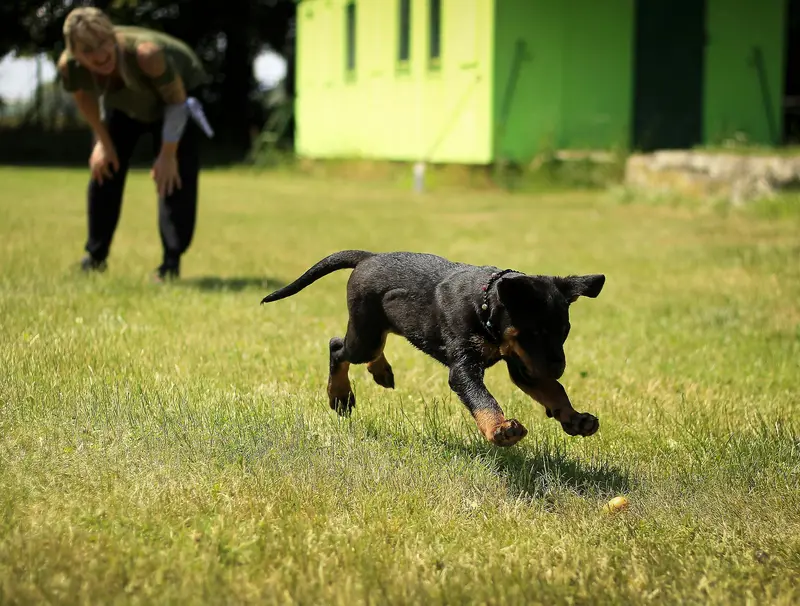
5. Mimicry Training
Dogs can learn by observing. Recent studies have explored how dogs mimic human behaviors, such as opening doors or flipping switches. Using this natural ability, trainers can teach dogs to replicate actions through demonstration.
Cognitive Development Activities
Beyond training, certain activities can further enhance a dog’s cognitive development:
- Teach New Tricks: Novel commands challenge the brain and prevent mental stagnation.
- Rotate Toys: Introducing new toys or rotating old ones keeps dogs curious and engaged.
- Socialization: Interaction with other dogs and humans improves adaptability and emotional intelligence.
- Problem-Solving Tasks: Set up obstacle courses or scenarios that require creative thinking.
Why Cognitive Training Matters
Enriching a dog’s mental life has numerous benefits, including:
- Improved Behavior: Mental stimulation reduces boredom, minimizing destructive behaviors.
- Stronger Bond: Working together on complex tasks deepens the human-dog relationship.
- Enhanced Longevity: A sharp mind contributes to overall health and happiness.
Conclusion
Advanced dog training is as much about cultivating intelligence as it is about teaching commands. By engaging your dog’s mind through innovative techniques and activities, you’re not just training them to obey—you’re helping them thrive. The next time you teach your dog a new trick or introduce them to a challenging game, remember: you’re not just communicating; you’re building a bridge where bark meets brain.