
The Truth About Animal Self-Awareness and Intelligence
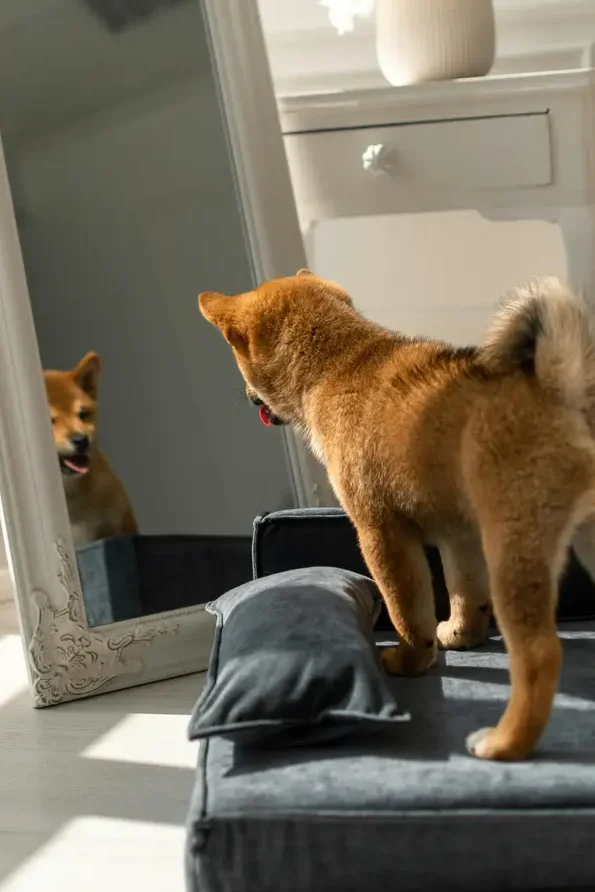
If you’ve ever watched your cat swat at its reflection or your dog bark at a “stranger” in the mirror, you might have wondered: do pets actually know they’re looking at themselves? The answer is more complicated than a simple yes or no. While mirrors can be a source of endless amusement for humans and animals alike, they also offer a window into something far more profound: self-awareness.
What Is the mirror test?
The mirror test was developed in 1970 by psychologist Gordon Gallup Jr. as a way to determine whether an animal possesses the ability of visual self-recognition. The method is simple in theory. A visible mark (usually paint or a sticker) is placed on an animal’s body in a place they can’t normally see, like their forehead or ear. If the animal looks in the mirror and uses it to inspect or touch the mark on themselves, it suggests they recognize the mirror image as their own reflection.
This behavior indicates a level of self-awareness that’s considered a marker of higher cognitive ability.
Who passes the mirror test?
Only a handful of species consistently pass this test of mirror self-recognition. These include:
- Great apes like chimpanzees, bonobos, and orangutans
- Bottlenose dolphins (through cognitive convergence)
- Orcas (killer whales)
- Elephants
- European magpies
- Some ants, surprisingly, under specific conditions
Each of these animals not only notices the mirror marks but also adjusts their behavior in response, showing curiosity or attempting to remove them. This level of interaction and awareness in animals hints at an understanding that “the animal in the mirror” is themselves.

do pets pass the mirror test?
Dogs and cats generally don’t pass the mirror test in the way apes or dolphins do. That doesn’t mean they lack cognitive capabilities—it might just mean they experience the world differently.
Dogs, for example, have a primary sense of scent rather than sight. For them, a mirror provides no useful smell cues, so it may not trigger much recognition. Some dogs lose interest in their mirror reflections after a few exposures, suggesting they realize it’s not another dog, but there’s little evidence they connect it to their own identity.
Cats also fail the mirror test, often treating the reflection as another animal or ignoring it completely. But these solitary animals have complex social behaviors and problem-solving abilities. It’s possible that the mirror test simply isn’t designed to capture how cats perceive themselves.
what does it really mean?
Failing the mirror test doesn’t mean an animal lacks intelligence or awareness—it might just mean the test isn’t a good fit for that species. Intelligence is multi-dimensional. Some creatures may not recognize themselves visually but show signs of self-awareness and even social intelligence in other ways—through memory, empathy, planning, or problem-solving.
Moreover, this test relies on visual cues, which isn’t fair to animals like dogs, who navigate the world primarily through their sense of smell. Imagine being tested on your intelligence using a method that ignores your strongest ability. That’s essentially what’s happening here.
conclusion
So, can pets recognize themselves in mirrors? In this sense, probably not. But that doesn’t mean your furry friends aren’t smart or self-aware in their own way. It just reminds us that intelligence comes in many forms, and not all of them look like our own.
Whether they recognize their reflections or not, one thing’s certain: they recognize you. And for most pet parents, that’s what matters most.
further information
https://www.akc.org/expert-advice/lifestyle/do-dogs-have-self-awareness/
https://en.wikipedia.org/wiki/Mirror_test
https://www.salon.com/2022/07/09/mirror-test-animal-cognition